Enterprise Risk Management Adoption in Malaysia: A Disclosure Approach

Authors

  • Salinah Hj Togok
  • Che Ruhana Isa
  • Suria Zainuddin

Abstract

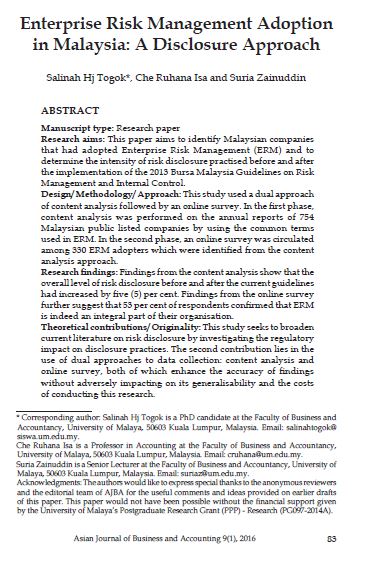
Manuscript type: Research paper
Research aims: This paper aims to identify Malaysian companies
that had adopted Enterprise Risk Management (ERM) and to
determine the intensity of risk disclosure practised before and after
the implementation of the 2013 Bursa Malaysia Guidelines on Risk
Management and Internal Control.
Design/ Methodology/ Approach: This study used a dual approach
of content analysis followed by an online survey. In the first phase,
content analysis was performed on the annual reports of 754
Malaysian public listed companies by using the common terms
used in ERM. In the second phase, an online survey was circulated
among 330 ERM adopters which were identified from the content
analysis approach.
Research findings: Findings from the content analysis show that the
overall level of risk disclosure before and after the current guidelines
had increased by five (5) per cent. Findings from the online survey
further suggest that 53 per cent of respondents confirmed that ERM
is indeed an integral part of their organisation.
Theoretical contributions/ Originality: This study seeks to broaden
current literature on risk disclosure by investigating the regulatory
impact on disclosure practices. The second contribution lies in the
use of dual approaches to data collection: content analysis and
online survey, both of which enhance the accuracy of findings
without adversely impacting on its generalisability and the costs
of conducting this research.

Practitioner/ Policy implications: The findings of the current study
reflect on the true ERM adoption rate in this part of the region
which is useful to practitioners who are still skeptical of ERM.
Knowing that more than half of the public listed companies have
implemented ERM may be the motivation for the non-adopters to
implement ERM. Moreover, findings will encourage policy makers
to introduce voluntary guidelines to regulate ERM implementation
and disclosure practices in Malaysia.
Research limitations/ Implications: The use of keyword search to
identify ERM adopters bears the conflict of substance over form,
particularly when the common terms in the disclosure do not
reflect the actual practices. Future research may need to address
the conflicts by using a score method that can help to improve the
scientific aspects of the methodology. A framework for the analysis
of risk communication and an index to measure the quality of risk
disclosure can further enhance the instrument.
Keywords: Annual Reports, Content Analysis, Disclosure, Keyword
Search, Enterprise Risk Management
JEL Classification: M41

Author Biography

  • Salinah Hj Togok

    Manuscript type: Research paper
    Research aims: This paper aims to identify Malaysian companies
    that had adopted Enterprise Risk Management (ERM) and to
    determine the intensity of risk disclosure practised before and after
    the implementation of the 2013 Bursa Malaysia Guidelines on Risk
    Management and Internal Control.
    Design/ Methodology/ Approach: This study used a dual approach
    of content analysis followed by an online survey. In the first phase,
    content analysis was performed on the annual reports of 754
    Malaysian public listed companies by using the common terms
    used in ERM. In the second phase, an online survey was circulated
    among 330 ERM adopters which were identified from the content
    analysis approach.
    Research findings: Findings from the content analysis show that the
    overall level of risk disclosure before and after the current guidelines
    had increased by five (5) per cent. Findings from the online survey
    further suggest that 53 per cent of respondents confirmed that ERM
    is indeed an integral part of their organisation.
    Theoretical contributions/ Originality: This study seeks to broaden
    current literature on risk disclosure by investigating the regulatory
    impact on disclosure practices. The second contribution lies in the
    use of dual approaches to data collection: content analysis and
    online survey, both of which enhance the accuracy of findings
    without adversely impacting on its generalisability and the costs
    of conducting this research.

    reflect on the true ERM adoption rate in this part of the region
    which is useful to practitioners who are still skeptical of ERM.
    Knowing that more than half of the public listed companies have
    implemented ERM may be the motivation for the non-adopters to
    implement ERM. Moreover, findings will encourage policy makers
    to introduce voluntary guidelines to regulate ERM implementation
    and disclosure practices in Malaysia.
    Research limitations/ Implications: The use of keyword search to
    identify ERM adopters bears the conflict of substance over form,
    particularly when the common terms in the disclosure do not
    reflect the actual practices. Future research may need to address
    the conflicts by using a score method that can help to improve the
    scientific aspects of the methodology. A framework for the analysis
    of risk communication and an index to measure the quality of risk
    disclosure can further enhance the instrument.
    Keywords: Annual Reports, Content Analysis, Disclosure, Keyword
    Search, Enterprise Risk Management
    JEL Classification: M41

Downloads

Published

30-06-2016

Issue

Section

Articles

How to Cite

Enterprise Risk Management Adoption in Malaysia: A Disclosure Approach. (2016). Asian Journal of Business and Accounting, 9(1), 83-104. http://jummec.um.edu.my/index.php/AJBA/article/view/2721

Most read articles by the same author(s)

1 2 > >>