NAVIGATION
Artificial Intelligence Policy
Ethics and Malpractice Statements


PAPER TEMPLATE

COPYRIGHT FORM





MEMBER OF

SUPPORTED SOCIETIES


SUPPORTED CONFERENCE
VISITORS

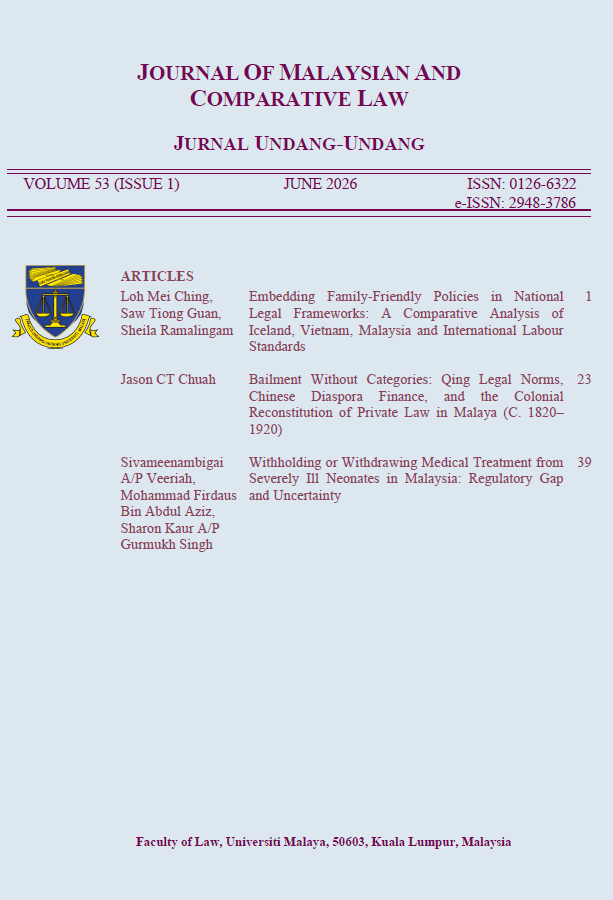
Editorial for (June 2026 Issue)
It is with great pleasure that we present the first issue of the Journal of Malaysian and Comparative Law (JMCL) for 2026. This issue brings together three thought-provoking articles that demonstrate the enduring value of comparative legal scholarship in addressing contemporary legal challenges. Although spanning diverse areas of law—labour law, legal history and private law, and medical law and ethics—the contributions share a common objective: to critically examine the adequacy of legal frameworks in responding to evolving social, economic, and moral realities. Collectively, they illustrate how comparative legal analysis can illuminate pathways for legal reform while deepening our understanding of the historical, cultural, and institutional foundations of law.
The opening article, "Embedding Family-Friendly Policies in National Legal Frameworks: A Comparative Analysis of Iceland, Vietnam, Malaysia and International Labour Standards", by Loh Mei Ching, Saw Tiong Guan, and Sheila Ramalingam, examines Malaysia's legal framework on family-friendly employment policies against the experiences of Iceland and Vietnam, with reference to the International Labour Organization's Workers with Family Responsibilities Convention 1981 (No. 156) and Maternity Protection Convention 2000 (No. 183). Through a doctrinal and comparative legal methodology, the authors analyse statutory provisions governing leave entitlements, employment protection, non-discrimination, childcare governance, and support for workers with caregiving responsibilities. Their analysis reveals that while Malaysia has made important strides through recent amendments to the Employment Act 1955, significant gaps remain when compared with more integrated models. Iceland's comprehensive framework of shared parental leave, flexible working arrangements, social insurance financing, and universal childcare, together with Vietnam's strong maternity income protection and state-supported childcare, provide valuable comparative perspectives. The article makes a compelling case for a more coherent and integrated legal framework that better supports work–family reconciliation and strengthens women's sustained participation in the Malaysian workforce.
The second contribution, "Bailment Without Categories: Qing Legal Norms, Chinese Diaspora Finance, and the Colonial Reconstitution of Private Law in Malaya (c. 1820–1920)", by Jason C. T. Chuah, offers a fascinating historical exploration of the interaction between Chinese legal traditions and British colonial jurisprudence. Particularly timely considering renewed public interest generated by the recent Southeast Asian film Dear You, which highlights the historical practice of qiaopi (letters of remittance), the article examines how Qing legal norms governing entrusted property shaped commercial relationships within Chinese diaspora communities in Malaya. Rather than organising disputes through abstract legal categories, Qing law evaluated relationships through concepts of trust, misuse, and social order. British colonial courts, however, reconstituted these relationships within the doctrinal categories of English private law, such as debt, bailment, and trust. The article argues that this process fundamentally transformed the normative character of Chinese commercial practices and altered the distributive consequences of legal relationships. More broadly, it challenges assumptions about the universality of private law concepts and offers an important reminder that legal categories are themselves products of historical and cultural traditions.
The third article, "Withholding or Withdrawing Medical Treatment from Severely Ill Neonates in Malaysia: Regulatory Gap and Uncertainty", by Sivameenambigai A/P Veeriah, Mohammad Firdaus Bin Abdul Aziz, and Sharon Kaur A/P Gurmukh Singh, addresses one of the most ethically and legally challenging issues in contemporary medical practice. Medical practitioners are frequently required to make profoundly difficult decisions regarding the withholding or withdrawal of life-sustaining treatment from severely ill neonates, often in circumstances where legal guidance remains uncertain. Drawing upon doctrinal and qualitative research, the authors identify significant regulatory gaps within the Malaysian legal framework. In contrast to jurisdictions such as the United Kingdom and the Netherlands, where legislation, judicial precedents, and clinical guidelines provide clearer guidance, Malaysia continues to rely principally on national clinical guidelines that lack comprehensive legal support. The article critically examines the relevant provisions of the Child Act 2001 and the Penal Code, highlighting the uncertainties surrounding the legality of such medical decisions. The authors advocate legislative reform alongside improvements to clinical practice guidelines to provide greater legal certainty for healthcare professionals while ensuring that decision-making remains ethically and medically sound.
Taken together, the contributions in this issue underscore the importance of law as a dynamic institution that must continually adapt to changing social conditions, historical understandings, and technological and medical developments. Whether examining the reconciliation of work and family responsibilities, the evolution of commercial legal norms across cultures and empires, or the regulation of complex medical decision-making, each article demonstrates the indispensable role of comparative legal scholarship in identifying both the strengths and limitations of existing legal frameworks. By engaging with international experiences and historical perspectives, the authors provide valuable insights that enrich contemporary legal discourse and inform future law reform in Malaysia.
Finally, we are pleased to announce that, beginning with this issue, JMCL has adopted a new article template developed by the Research Journals Management, Universiti Malaya. This initiative forms part of our continuing efforts to enhance the consistency, accessibility, and professional presentation of the Journal while supporting authors through a more streamlined publication process. We hope that this new format will further strengthen the quality and visibility of the scholarship published in JMCL.
We trust that readers will find the articles in this issue both intellectually stimulating and practically relevant, and we thank our authors, reviewers, and editorial team for their invaluable contributions to the continued success of the Journal of Malaysian and Comparative Law.
Associate Prof. Dr. Mohammad Ershadul Karim
NAVIGATION
Artificial Intelligence Policy
Ethics and Malpractice Statements
MEMBER OF
SUPPORTED SOCIETIES
SUPPORTED CONFERENCE
VISITORS